
BongoBongo Uganda: licence, account access and safety checks
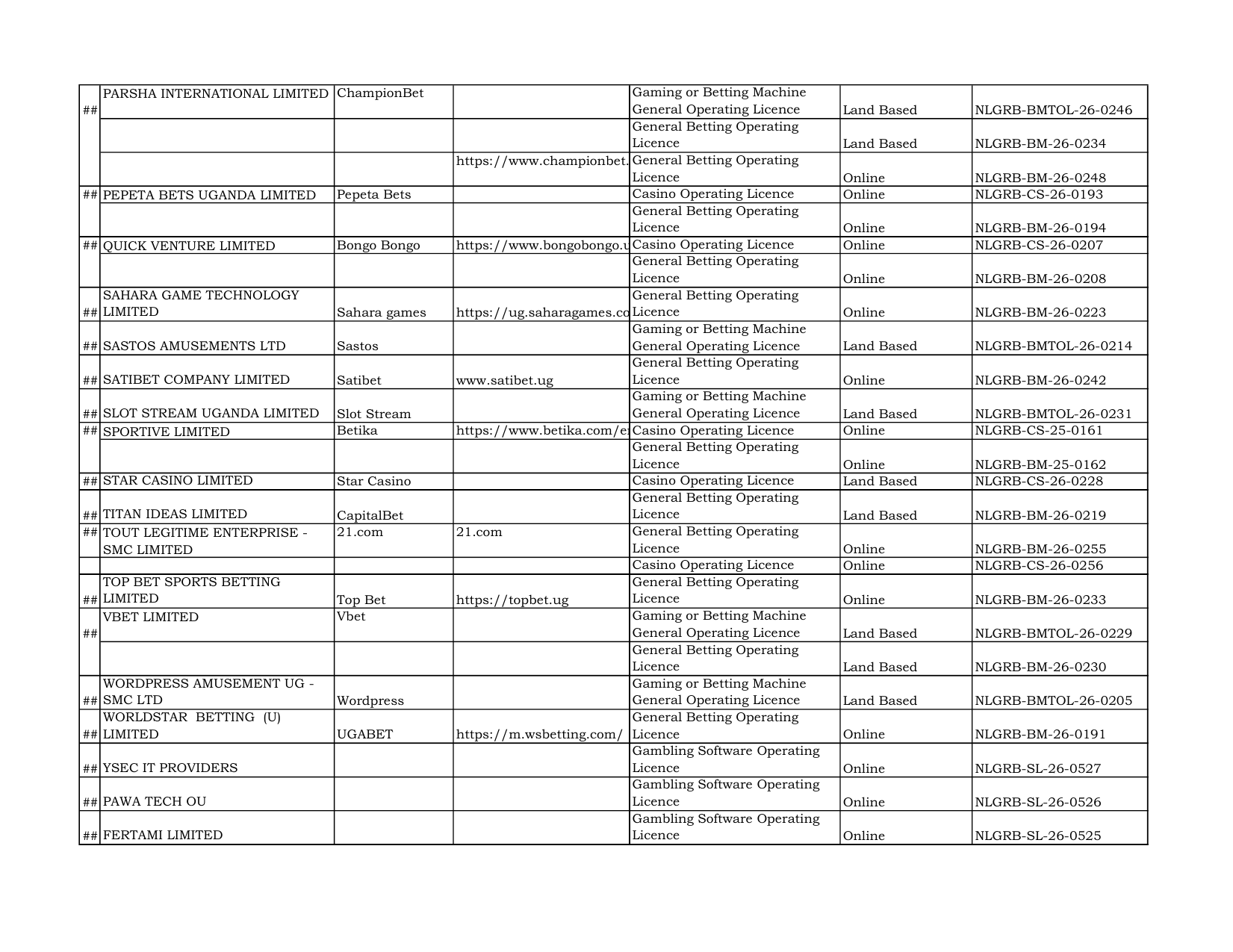
A BongoBongo Uganda account that suddenly becomes inaccessible creates two separate questions. The urgent question is how to preserve evidence and request access or a balance explanation. The broader question is whether the account was opened on the licensed Ugandan host or on an imitation. The available primary record answers the identity question: the 2026 National Lotteries and Gaming Regulatory Board notice matches bongobongo.ug to QUICK VENTURE LIMITED and lists NLGRB-CS-26-0207 and NLGRB-BM-26-0208.
That exact host–operator–licence match supports a green identity signal. It does not prove that every login restriction, KYC decision or withdrawal will be resolved correctly. No account file, balance statement, payment test, withdrawal test or operator response was supplied. A locked player should therefore document the incident rather than assume either fraud or routine verification.

Verdict: legitimate licensed identity, but account outcomes remain untested
On the evidence checked on 20 August 2026, BongoBongo Uganda has a current primary-record match strong enough for a green signal. The regulator’s 2026 licensed-companies notice places the domain, company and two licence numbers together. That is the precise comparison needed when deciding whether the named Ugandan operation has a recognised licensed identity.
| Identity element | Verified record | Practical meaning |
|---|---|---|
| Exact host | bongobongo.ug | Type and compare this host before entering credentials or sending money |
| Named operator | QUICK VENTURE LIMITED | The company name should agree with regulatory and formal account records |
| Listed licences | NLGRB-CS-26-0207; NLGRB-BM-26-0208 | Both identifiers appear beside the host and operator in the 2026 notice |
| Evidence date | 20 August 2026 | The finding reflects the supplied record as checked on that date |
| Review signal | Green | Current primary evidence supports the exact identity, not every service outcome |
“Legitimate” is therefore limited to the documented identity and licensing match. It is not a promise of quick withdrawals, uninterrupted access, fair handling of every dispute or recovery of a particular balance. The supplied expiry field is blank, and no expiry date should be invented. The Board’s principal-expiry report can provide status information about principal applications, but it is not a licensed-domain register and was not used to award the green signal.
Exact host, operator and licence match
The strongest evidence is the single-row relationship between bongobongo.ug, QUICK VENTURE LIMITED, NLGRB-CS-26-0207 and NLGRB-BM-26-0208. A similar name, social-media profile, messaging contact or alternative domain would not inherit that finding. The signal applies only where the browser’s hostname is exactly the recorded host.
| Check | Must match | Stop condition |
|---|---|---|
| Address bar | bongobongo.ug | Added words, changed spelling, another suffix or an unrelated subdomain |
| Operator identity | QUICK VENTURE LIMITED | A different company is presented as the licensed Ugandan operator |
| Licence references | NLGRB-CS-26-0207 and NLGRB-BM-26-0208 | Missing, altered or substituted identifiers when licensing is claimed |
| Secure session | Browser shows an encrypted connection without a certificate warning | Certificate warning, forced download or unexpected credential prompt |
| Payment instructions | Instructions remain consistent within the authenticated account | Payment requested through an unsolicited personal contact or changed recipient |
Use the licence-check procedure when any element differs. A logo is not enough: copied graphics can appear on a clone, while the regulator’s host-to-company record is specific. Likewise, possession of a licence number in a message does not establish that the sender controls the licensed host.
Locked account: preserve the incident before escalating
If access fails while money may remain in the account, begin with preservation. Record the date and local time, the exact host, the error wording, the device and browser used, and whether password recovery arrived through an expected channel. Keep original deposit confirmations, withdrawal requests, transaction references and earlier account messages. Do not edit screenshots in a way that removes timestamps, addresses or reference numbers.
A locked account can have several possible causes, including a forgotten credential, security intervention, KYC review or an operator restriction. None is established in the supplied packet. The existence of a licence also does not determine why a particular account was restricted. Describe only what happened: for example, “login rejected after a withdrawal request at 14:10” is useful; “the operator stole the balance” is a conclusion that requires evidence.
| Evidence to preserve | Why it matters | What not to expose publicly |
|---|---|---|
| Full-page login error with host visible | Connects the incident to the exact domain and time | Passwords, one-time codes and recovery answers |
| Deposit and withdrawal references | Allows transactions to be traced in a complaint | Full card details, PINs or mobile-money secrets |
| Account identity and KYC correspondence | Shows requests, submissions and responses | Unredacted identity documents on public forums |
| Balance display or last statement | Records the amount shown before access failed | Unnecessary personal and financial information |
| Support correspondence | Establishes chronology and promised actions | Private contact details not needed by the recipient |
Retry only through the known host, not through a link sent by an unknown contact. Avoid repeated password attempts if they may extend a security lock. Do not pay a “reactivation”, “tax release” or “verification” charge merely because a stranger claims it will unlock funds. No such charge is supported by the supplied evidence.
Payments and withdrawals: what is known and unknown
No payment method, deposit limit, fee, processing time or supported bank or mobile-money channel was supplied. No successful deposit or withdrawal was independently tested. It would therefore be unsafe to name methods or quote timelines. The appropriate conclusion is not that payments are poor or excellent, but that transaction performance remains unverified.
Before depositing, capture the cashier terms visible inside the authenticated host, including minimums, maximums, fees and the displayed recipient. Compare the recipient shown at confirmation with the recipient on the completed transaction record. If the details change after contact through messaging or social media, pause and seek clarification through the operator’s established support route.
For a withdrawal, save the request time, amount, reference, status and any stated review requirement. If the account is then locked, preserve both the withdrawal record and the access failure. A complaint framed around those timestamps is stronger than a general accusation. The payment-check checklist explains how to record transaction evidence without treating an advertised method as proof of successful payout.
Do not deposit extra money solely to test whether an inaccessible balance can be released. Do not allow a third party to take remote control of the device or receive a one-time code. The green licence signal does not remove ordinary payment, impersonation or account-security risks.
KYC and the missing account record
The supplied packet contains no BongoBongo Uganda KYC rules, no request for documents, no submitted document set and no decision on an individual account. It also contains no evidence that verification caused the hypothetical lock. Any account-specific KYC conclusion would therefore be speculation.
If verification is requested, ask for the purpose, required documents, accepted format, secure submission route and any deadline. Retain the request and proof of submission. Send only what is necessary through a channel attributable to the exact host; never send identity documents to an unverified messaging account. Redact documents only where the operator confirms that redaction is acceptable, because an altered document may be rejected.
Uganda’s consolidated gambling law defines a minor as a person under 25, creates the Board and requires relevant operating licences. The consolidated Act is the primary legal reference supplied for those points. Anyone under 25 should not attempt to open or verify a gambling account. Adults should still treat identity files as sensitive information and retain a record of where and when each file was submitted.
Complaint and escalation route for an inaccessible balance
Start with a concise written request to the operator through a support channel reached from the exact host. Include the account identifier, incident date, disputed amount if known, transaction references, the steps already attempted and the resolution requested. Ask for a case number and a written reason for the restriction. Do not send passwords, PINs or one-time codes.
Allow the stated response period if one was provided, but preserve every deadline. If the response does not address the evidence, send one organised follow-up that identifies the unanswered points. The complaints guide provides a structure for chronology, attachments and requested remedy.
Escalation material should distinguish proven facts from allegations. State that the account became inaccessible, a withdrawal remained pending or a balance was displayed only when records support those statements. Do not claim criminal conduct from a delay alone. For regulatory escalation, include the exact domain, QUICK VENTURE LIMITED and the two listed licence numbers so the complaint can be tied to the correct licensed identity.
If gambling is causing immediate financial or emotional harm, stop depositing and use urgent support options. Account recovery should not become a reason to chase losses or borrow money. The responsible-gambling guidance covers practical limits and stopping measures.
Clone and impersonation checks
The licensed identity can be copied into a convincing imitation. Fraudsters may reproduce a name, logo or licence number while changing the host or payment destination. The most important comparison is therefore the browser hostname, followed by the operator name and licence references.
Treat spelling changes, extra hyphens, alternative suffixes and links shortened by third parties as separate destinations. Open a known address independently instead of following an unsolicited login link. A certificate warning, unexpected app download, request for screen sharing or demand for credentials through chat should stop the process.
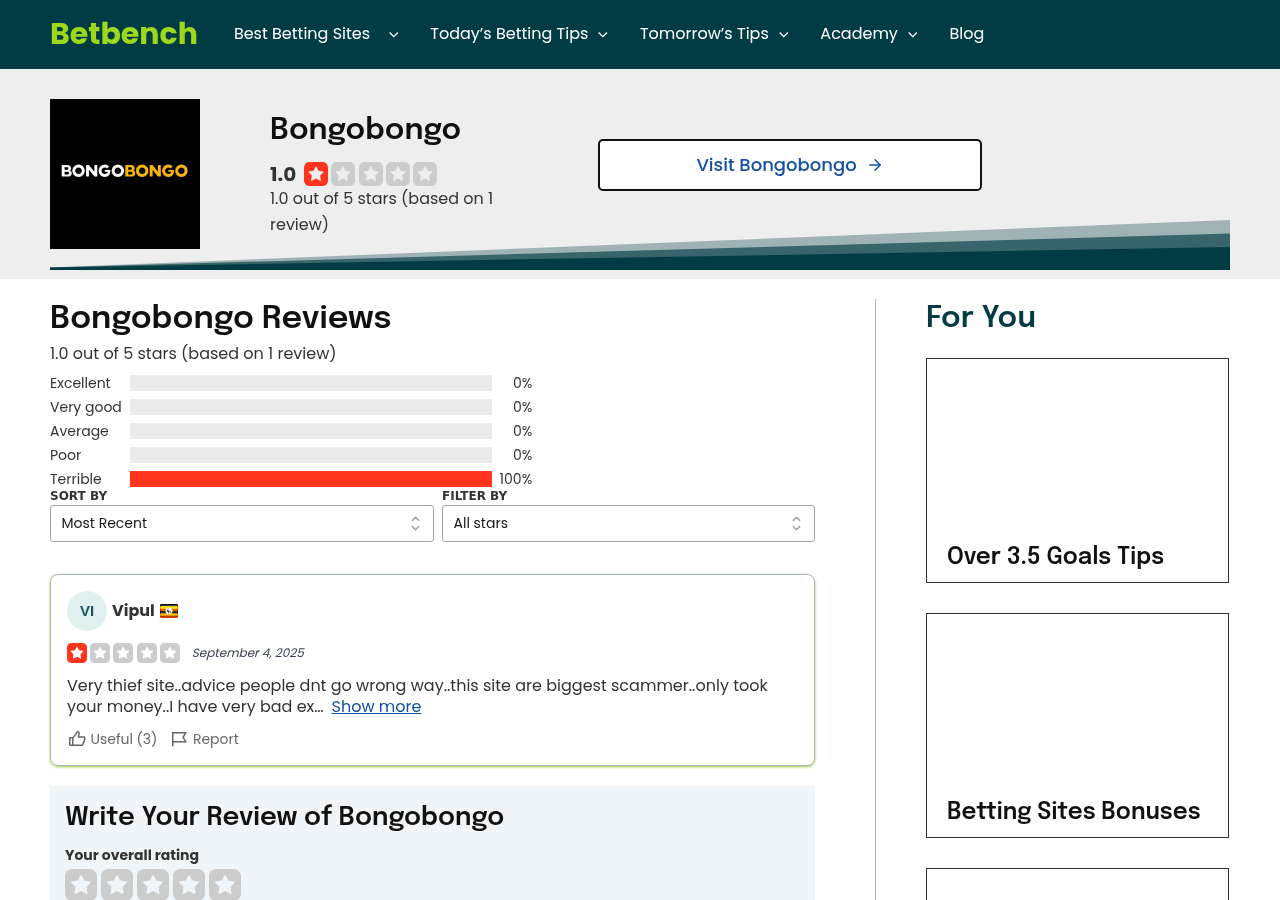
The supplied user-context source hosts a review with a small sample. One report cannot establish how BongoBongo Uganda generally handles accounts, KYC or withdrawals. It does not override the regulator’s identity record, nor can it prove that a reported event involved the exact licensed host. User reports may suggest questions to investigate, but they are not a substitute for transaction records or a competent official finding.
Scam-or-legit and legal-or-not assessment
For the exact domain bongobongo.ug, the current supplied primary record supports a legitimate licensed identity in Uganda. QUICK VENTURE LIMITED and licences NLGRB-CS-26-0207 and NLGRB-BM-26-0208 are matched to that host in the 2026 notice. That is why the signal is green rather than amber.
The legal conclusion must remain precise. The evidence supports the listed operation’s licensed status; it does not make every similarly named website legal, validate an off-site agent or resolve an individual contract dispute. The supplied licence-expiry field is empty. Although the separate live expiry report was checked, it is not a domain register and does not supply a licence-expiry date for this dossier.
“Not a scam” is also too broad if used as an unconditional guarantee. No official adverse record about the exact identity was supplied, and the contextual user sample is too small to establish general misconduct. Conversely, no withdrawal test, customer-support test or account-resolution file was supplied. The defensible finding is a verified licensed identity with open service-performance questions.
Readers who accept those limits may use the single supplied route to See the playing route. Verify the final hostname before signing in or paying.
Evidence chronology, method and correction path
The evidence was checked on 20 August 2026. The primary step was to compare the exact host, legal operator and licence identifiers in the regulator’s 2026 notice. The legal reference was used only for the supplied points about the Board, operating licences and the under-25 definition. The principal-expiry report was treated as a different type of record and not as proof that a domain is licensed.
The contextual review capture was kept in a lower tier because its small user sample cannot establish general conduct. No unsupported average, complaint rate or payout conclusion was calculated. No personal account, deposit, withdrawal, KYC or support interaction was tested. The methodology therefore separates identity evidence from operational performance; further details are available in the review methodology.
| Date checked | Record | Finding | Evidential limit |
|---|---|---|---|
| 20 August 2026 | 2026 licensed-companies notice | Exact match for bongobongo.ug, QUICK VENTURE LIMITED and two licences | Does not prove individual account outcomes |
| 20 August 2026 | Principal-expiry report | Report provides principal-application expiry status | Not used as a licensed-domain register or expiry proof here |
| 20 August 2026 | Consolidated Act | Supports the supplied legal and age-related points | Does not decide a private account dispute |
| 20 August 2026 | Third-party review capture | Provides limited user context | Small sample; cannot establish general conduct |
A correction should identify the disputed sentence and provide a dated regulator record, operator correspondence, complete transaction record or other competent evidence. Sensitive documents should be redacted before submission. Use the contact route for a correction request. Until stronger evidence is supplied, missing payment terms, KYC practice, account balance, withdrawal result, support response and licence expiry remain unknown rather than inferred.
Frequently asked questions
Is BongoBongo Uganda licensed in Uganda?
Yes, for the exact identity checked. The 2026 regulator notice matches bongobongo.ug to QUICK VENTURE LIMITED and lists NLGRB-CS-26-0207 and NLGRB-BM-26-0208. The finding does not extend to similarly named domains or off-site agents.
Is BongoBongo Uganda a scam or legitimate?
The supplied current primary record supports a legitimate licensed identity for bongobongo.ug. No official adverse record was supplied. However, no withdrawal, support or locked-account outcome was independently tested, so the green signal is not a guarantee of every transaction or dispute result.
What should I do if my BongoBongo Uganda account is locked?
Record the exact host, date, error message, balance evidence and transaction references. Contact support through the exact host, request a case number and written reason, and preserve every response. Do not share passwords or one-time codes, and do not pay an unverified person to unlock the account.
Which payments and withdrawal times are verified?
None were supplied or independently tested. The evidence packet does not establish supported methods, fees, limits or processing times. Capture the cashier terms and transaction reference shown in the authenticated account before paying or requesting a withdrawal.
Is BongoBongo Uganda’s KYC process verified?
No account-specific KYC process or outcome was supplied. If documents are requested, confirm the purpose, required files and secure submission route through the exact host, then retain the request and proof of submission. People under 25 should not attempt to open or verify a gambling account in Uganda.
Where can I complain about a locked account or missing balance?
Begin with a written operator complaint containing the account identifier, chronology, disputed amount, transaction references and requested remedy. Ask for a case number. If escalation becomes necessary, identify bongobongo.ug, QUICK VENTURE LIMITED and both listed licence numbers, while separating documented facts from allegations.