
GSB Uganda review: domain, licence and safety checks
Suspicious-address decision
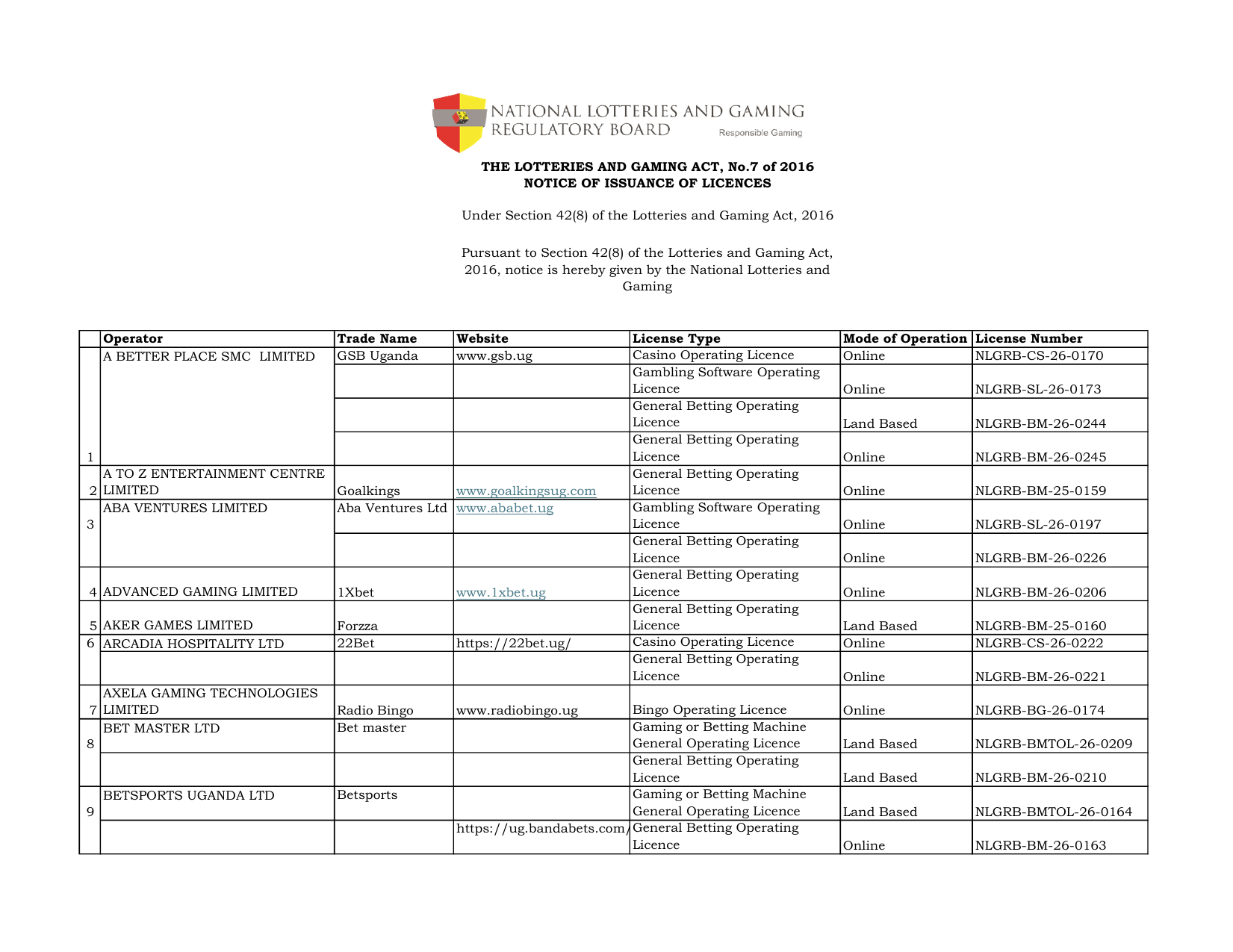
The hostname decision is straightforward but limited: gsb.ug matches the domain recorded for A BETTER PLACE SMC LIMITED in Uganda’s 2026 licensed-companies notice. That is strong primary evidence for the precise host and operator pairing, so the overall signal is green on the licence-and-identity question. It is not a promise that every payment will be quick, that every account decision will be correct, or that a player will win.
The check matters because a familiar name can be copied onto a different address. A page using a similar logo, a different spelling, a shortened link, or a look-alike domain should not inherit the status of gsb.ug. The verified record identifies the host, the legal operator and four licence references together. That combination is more useful than a logo or search result alone.

What the primary record establishes
The 2026 notice matches A BETTER PLACE SMC LIMITED to gsb.ug. It lists these references: NLGRB-CS-26-0170, NLGRB-SL-26-0173, NLGRB-BM-26-0244 and NLGRB-BM-26-0245. The source was checked on 20 August 2026. This is the central evidence behind the green signal.
The match supports a conclusion that the named operator and domain appear together in the current primary record supplied for this review. It does not establish an expiry date: the packet contains no licence-expiry value. It also does not establish the precise services attached to each reference, the payment instruments available at a particular moment, or the result of an individual withdrawal.
| Identity field | Verified position | Practical meaning |
|---|---|---|
| Domain | gsb.ug | This is the host matched in the 2026 notice. |
| Operator | A BETTER PLACE SMC LIMITED | This is the legal name paired with the host in that record. |
| Licence references | NLGRB-CS-26-0170; NLGRB-SL-26-0173; NLGRB-BM-26-0244; NLGRB-BM-26-0245 | Record the references exactly when checking support or regulator information. |
| Expiry | Not supplied | Do not treat the green signal as confirmation of an expiry date. |
For legal context, the supplied consolidated Act says that a minor is under 25, establishes the Board and requires relevant operating licences. That gives the regulatory setting for the record, but it does not add facts about this operator beyond the listed match.
Host, operator and licence match
A reliable identity check has three parts. First, read the address bar rather than relying on a bookmark image or an advert. Second, compare the host character by character with gsb.ug. Third, compare the legal operator and all listed references with the primary notice. A mismatch in any one of those fields should pause the registration or deposit until clarified.
Do not replace the exact host with a subdomain, redirect, mobile address or messaging-app link without checking where it resolves and which operator is named there. The packet verifies the domain shown above; it does not verify every possible alternate address. A page can look identical while sending credentials or payments somewhere else.
The primary notice is the best source for the identity conclusion because it is a regulator-facing record, not a marketing statement. The licensing report supplied separately is useful for expiry-status context, but its stated limitation is important: it is a report for principal applications, not a licensed-domain register. It therefore should not be used alone to award a green signal.
Check the 2026 licensed-companies notice for the exact row and references.
Clone and scam checks
The safest clone check begins before login. Type the verified host yourself or use a previously confirmed bookmark, then inspect the spelling, ending and secure connection. Compare the visible operator name with A BETTER PLACE SMC LIMITED and compare the licence references rather than only the colour scheme. A social-media account, forwarded message or “support” number is not proof that it controls the verified service.
| Check | What to compare | Stop signal |
|---|---|---|
| Address | Exact host: gsb.ug | Extra words, substituted letters, or a different domain ending. |
| Legal identity | A BETTER PLACE SMC LIMITED | A different company name or no operator name. |
| Regulatory references | All four listed references | Missing, altered or unexplained numbers. |
| Payment destination | Recipient details shown before confirmation | A personal account, a new recipient, or a request outside the normal account flow. |
| Login and support | The same verified host and consistent help route | A request for passwords, one-time codes or remote access. |
A clone can copy the logo, so the supplied logo is only a visual identifier, not independent licence evidence. Never send a password, PIN or one-time verification code to someone claiming to “unlock” a withdrawal. Keep payment confirmations and messages if a dispute develops. Those records can help show what happened, although they do not prove the merits of a complaint by themselves.
Payments: what is and is not verified
The evidence packet contains no verified list of deposit methods, no fee schedule, no minimum or maximum transaction values and no independently tested payment route. It would therefore be unsafe to name mobile-money services, cards, bank channels, wallets or processing times as available facts. Payment availability may depend on the account, channel, verification status and current terms; none of those details is supplied here.
Before depositing, record the amount, currency, displayed recipient, transaction reference and time. Read the final confirmation screen, especially where a payment provider or beneficiary name differs from the brand wording. A successful deposit does not establish that a withdrawal will follow the same route or speed.
| Payment question | Evidence status | Sensible action |
|---|---|---|
| Which methods are available? | Unknown from the packet | Check the verified account flow before committing funds. |
| Are fees charged? | Unknown | Confirm the final amount and retain the receipt. |
| How long do deposits take? | Unknown | Do not rely on an advert or an informal promise. |
| How long do withdrawals take? | No test supplied | Ask for the applicable rule and keep the request record. |
| Can a third party pay? | Unknown | Avoid sending funds where the named recipient is unclear. |
The absence of a supplied test is not evidence of failure. It is simply an evidence boundary. A careful reader should treat payment claims as current account information to verify, not as a conclusion from the licence match.
Withdrawals, KYC and account controls
No withdrawal test is included. There is consequently no supported statement about processing time, rejected withdrawals, partial payments, reversal patterns or the documents requested during a payout. The same caution applies to KYC: the packet does not specify acceptable identity documents, address checks, source-of-funds checks, age checks beyond the legal context, or review times.
In practical terms, complete registration details accurately, use an account and payment instrument in your own name where the applicable rules require it, and do not upload documents through an unverified link. Check the exact request inside the verified host before sending anything. Redact unnecessary information where possible, but do not alter a document in a way that makes it unreliable.
A KYC request is not automatically evidence of wrongdoing; regulated services commonly need account information. Equally, a request for a password, PIN or one-time code is not a normal substitute for identity verification. If an account is restricted, save the notice, the date, the amount involved and each support response. Without a dated test or account record, this dossier cannot grade the withdrawal experience.
Complaints and the documented dispute
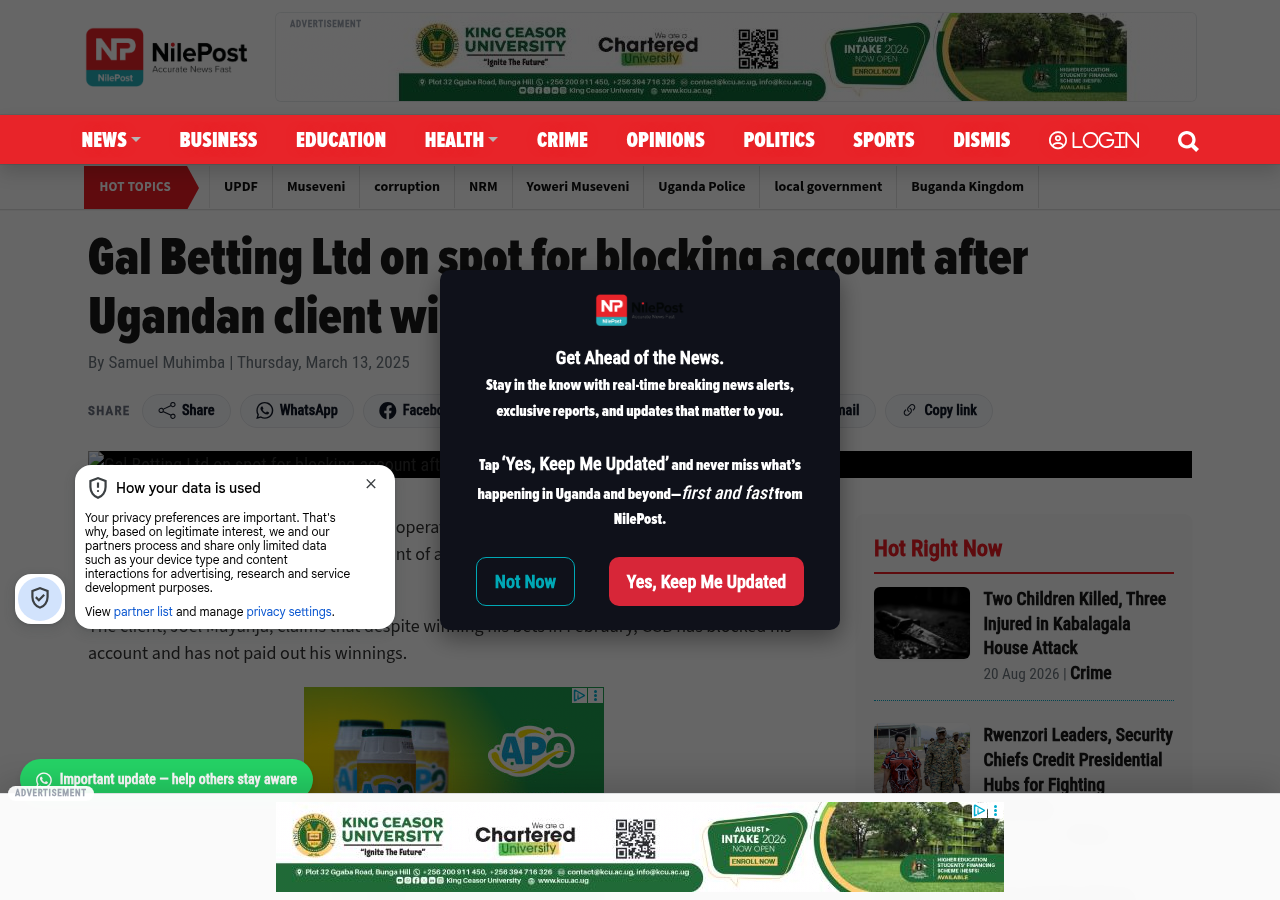
The packet includes a 2025 report describing a named player allegation involving an account being blocked after a reported win of Shs15m and recording the operator’s stated response. The supplied classification is user context. It records a dispute, not a final finding against the operator, and it does not establish that the allegation was proved.
A sensible complaint sequence is to contact support through the verified host, state the account issue plainly, attach the relevant transaction or verification references, and ask for a written reason and next step. Set a reasonable follow-up date. Keep the original wording, timestamps and attachments. If the matter remains unresolved, use the applicable regulator-facing route rather than relying on an unverified intermediary. The supplied packet does not provide a complaint reference, adjudication, settlement or regulator decision, so none can be claimed.
For the distinction between a report and a finding, the context report can be read as a dated dispute account, not as proof of liability.
Legal position, risks and limits
On the supplied current primary evidence, the legal-or-not question has a green answer for the precise host-and-operator match: gsb.ug is paired with A BETTER PLACE SMC LIMITED in the 2026 notice, alongside four licence references. The conclusion is narrower than “every aspect of the service is risk-free”. Licensing does not remove ordinary financial, privacy, account-access or gambling risks.
The supplied law says that a minor is under 25. Anyone considering gambling should verify the applicable age and participation rules, understand the cost of play and avoid using borrowed funds. Set a firm spending limit before depositing and stop if play is affecting necessities, relationships or sleep. A licence signal is not a prediction of results and does not turn gambling into income.
| Supported conclusion | Not established by this packet |
|---|---|
| The precise host is matched to the named operator in the 2026 notice. | A licence expiry date. |
| Four licence references are listed for that pairing. | A tested withdrawal outcome or processing time. |
| A 2025 dispute report exists as user-context evidence. | A final finding that the operator blocked funds improperly. |
| The legal framework requires relevant operating licences. | Current payment methods, fees or KYC turnaround. |
The key risks are therefore practical: entering a clone, paying an incorrect recipient, misunderstanding account rules, sharing sensitive credentials, or spending more than intended. These risks remain relevant even where the identity check is positive.
Evidence chronology and verification method
The primary notice and the related records were checked on 20 August 2026. The chronology used here is deliberately simple: the 2026 licensed-companies notice supplies the host, operator and references; the legal source supplies the regulatory context; the 2025 report supplies a dated dispute allegation and the operator’s stated response; and the expiry report supplies a limitation about what that report can show.
The method gives greatest weight to the current primary record for identity. Operator statements are not treated as independent proof, and user reports are labelled as allegations or context unless a competent dated source establishes a final finding. A green signal is used because current primary evidence supports the precise domain and entity. It is not based on the logo, the dispute report or an assumption about payments.
The record should be rechecked if the host changes, the operator wording changes, a licence reference is removed, an official adverse notice appears, or a new dated finding resolves the reported dispute. Until then, unknowns should remain unknown rather than being filled with assumptions.
licensing.lgrb.go.ug · ulii.org
Quick verification checklist and correction path
Before opening an account, confirm the address bar, operator name and four references. Before paying, confirm the recipient and final amount. Before requesting a withdrawal, read the current account rule and save the request reference. During KYC, use only the verified flow and protect credentials. During a complaint, preserve dates, amounts, screenshots and replies.
If a factual error is found, keep the correction precise: identify the statement, provide a dated competent source or a clear transaction record, and explain what changed. A correction request should not ask for unsupported praise or removal of a documented allegation merely because it is inconvenient. The appropriate outcome may be an update, qualification or warning, depending on the evidence.
For additional checks, use the internal licence checks, payment checks, complaints guidance and methodology. If the identity and risk checks are satisfactory and you choose to proceed, the available route is See the playing route.
Is GSB Uganda legal in Uganda?
The supplied 2026 primary notice matches gsb.ug to A BETTER PLACE SMC LIMITED and lists four NLGRB references. That supports a green legal-and-identity signal for the precise host, but it does not establish an expiry date or guarantee every service outcome.
How can I check that I am on the genuine host?
Compare the address character by character with gsb.ug, then compare A BETTER PLACE SMC LIMITED and the four listed NLGRB references with the 2026 notice. Do not rely on a copied logo, forwarded link or informal support account.
Which payment methods does the operator accept?
The packet does not verify any current deposit method, withdrawal method, fee, limit or processing time. Check the verified account flow and the final recipient details before paying, and keep the transaction reference.
Has a withdrawal been tested?
No. The packet contains no withdrawal test, so there is no supported conclusion about speed, rejection, reversal, partial payment or KYC review during a payout.
What should I do if my account or withdrawal is disputed?
Contact support through the verified host, provide the transaction and verification references, and request a written reason and next step. Keep dates, messages and receipts. If unresolved, use the applicable regulator-facing complaint route.
Does the reported blocked-account story prove wrongdoing?
No. The supplied 2025 report records a named player allegation and the operator’s stated response. It is user-context evidence of a dispute, not a final finding or proof of liability.